
When selecting a 4K PTZ camera for home or business surveillance, it’s easy to assume that all “zoom” cameras work the same.
In reality, there’s a critical difference between true motorized optical zoom and hybrid digital zoom.
This detailed comparison between the Camius SCOUT4K4XPTZ, 4K PoE PTZ camera and the Reolink TrackMix PoE shows how their hardware, image processing, and AI functions differ in real-world performance.
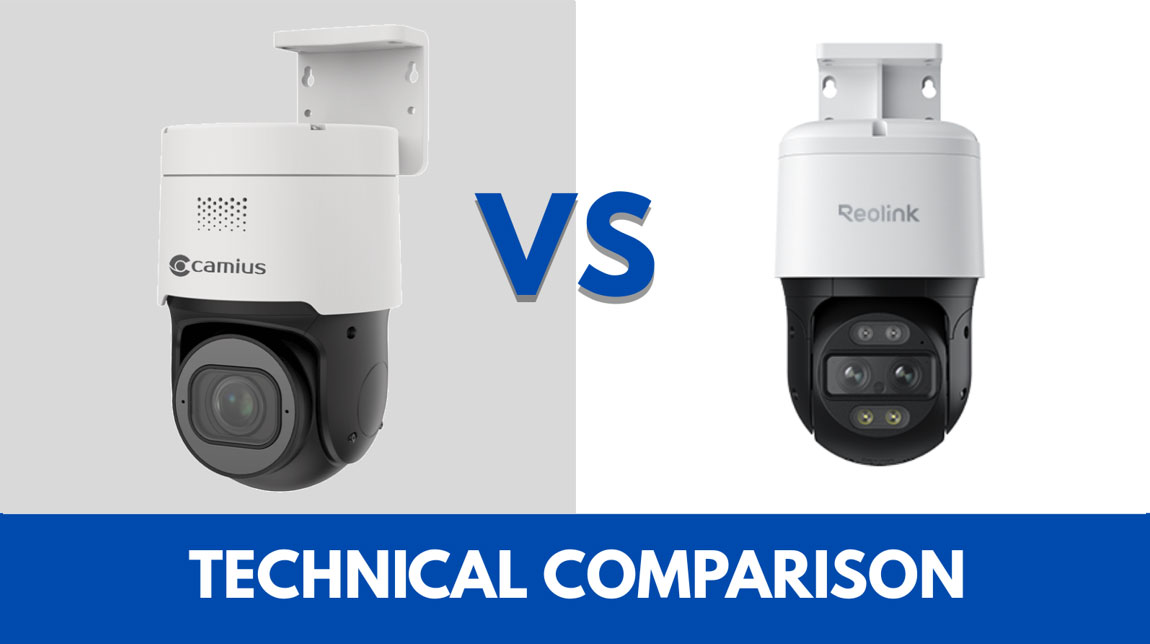
Technical Overview
| Feature | Camius SCOUT4K4XPTZ | Reolink TrackMix PoE | Detailed Overview |
|---|---|---|---|
| Image Sensor | 1/2.7″ Progressive Scan CMOS | Dual: 1/3″ + 1/2.8″ CMOS | Camius uses one larger, balanced sensor for true optical clarity and consistent color, while Reolink switches between two smaller ones. |
| Resolution | 3840×2160 (4K UHD) @ 30 fps | 3840×2160 (4K UHD) @ 25 fps | Both record in 4K, but Camius supports a smoother frame rate (30 fps) and more resolutions for flexible setup. |
| Compression | H.265+/H.265/H.264+/H.264 | H.265/H.264 | Camius supports enhanced compression for smaller file sizes with less quality loss. |
| Multiple Stream Support | 3 simultaneous video streams (Main, Sub, Mobile): Each stream can be encoded independently in H.265+ or H.264+, giving installers fine control over storage and network load. | 2 video streams (Main and Sub) | Camius lets you stream at different resolutions simultaneously — for example, record full 4K to the NVR while viewing a lighter HD or SD feed on mobile. This reduces bandwidth load and keeps playback smooth even on limited internet connections. Reolink supports only two streams, so you get less flexibility for multi-device monitoring or recording at different quality levels. |
| Bitrate Range | 8 kbps – 16384 kbps | 128 kbps – 8192 kbps | Higher bitrates delivers sharper video and better color depth. |
| Audio | Built-in mic & speaker (2-way, G.711) | Built-in mic & speaker | Both support 2-way audio, but Camius offers cleaner encoding for voice clarity. |
| Minimum Illumination | 0.009 Lux (Color), 0 Lux with IR | 0 Lux with spotlight | Camius captures color in lower light without needing white LEDs, reducing glare and light pollution. |
| Lens Type | Motorized varifocal | Dual fixed lenses | Camius physically zooms using a motorized lens, preserving full 4K detail. Reolink digitally simulates zoom, losing sharpness. |
| Focal Length | 2.8–12 mm | 2.8 mm + 8 mm | Camius adjusts continuously through optical zoom; Reolink switches between two lenses with no in-between range. |
| Zoom Capability | 4× True Optical Zoom | 6× Hybrid (Digital + Dual Lens) | Camius provides real magnification with no pixel loss. Reolink enlarges digitally, reducing image quality. |
| Aperture | F1.6 | F1.6 | Both let in similar light, but Camius uses a higher-grade lens assembly for cleaner low-light images. |
| Field of View (FOV) | 113°–31° (wide-tele) | 104°–38° | Camius covers a wider angle at full zoom-out, giving broader coverage and flexibility. |
| Focus | Auto-focus + software re-focus | Fixed focus per lens | Camius SCOUT4K4XPTZ uses a motorized varifocal lens that physically adjusts its internal glass elements when zooming. The focus motor works in tandem with zoom position data to maintain sharpness automatically across the entire zoom range (2.8–12 mm). You can also send a “Re-Focus” or “Auto Focus” command from the NVR or web interface if environmental lighting changes. Reolink TrackMix PoE doesn’t have a moving optical lens. It switches between two separate lenses — one wide, one telephoto — and relies on digital processing to “blend” or crop the image. Each lens has a fixed focus distance. When switching, the system estimates focus using software rather than a true lens adjustment. Camius delivers consistent, optical precision at every focal length. Reolink can appear sharp only at preset lens distances and often loses clarity during zoom transitions. |
| Focus Control | Optical motor inside lens | Software crop and switch | Because Camius continuously monitors focal distance and zoom position, it refocuses dynamically when objects move closer or farther. Reolink lacks mechanical control of focus, so any fine adjustment must be compensated digitally, reducing detail and sometimes creating soft edges or ghosting. Motorized optics allow the camera to maintain proper depth-of-field — meaning both near and far objects remain clear when needed. Reolink’s fixed lenses can’t adjust for this, so objects outside the primary focus range can appear slightly blurred, especially under infrared at night. |
| Impact on AI Accuracy | High (edge clarity retained) | Moderate (depends on digital correction) | Camius’s focus stability enhances AI accuracy for license plate recognition, human/vehicle classification, and facial features. AI algorithms rely on edge definition, and optical precision keeps edges crisp. Hybrid or digital zoom systems often misclassify blurred shapes under movement or low light. |
| PTZ Range / Speed | Pan 350°, Tilt 0–90° Pan 0.6–54°/s, Tilt 0.6–52°/s | Pan 355°, Tilt 0–90° Pan 2.5–90°/s, Tilt 1.5–60°/s | Camius moves slower when zoomed in for fine adjustments; Reolink is faster but less precise. |
| Presets | 255 presets, 3D positioning | 64 patrol points | Camius can memorize many more camera angles, great for large area patrols. |
| Auto Tracking | Yes (AI-linked PTZ tracking) | Yes (digital tracking) | Camius links PTZ motion to real AI triggers for accurate following. Reolink relies on basic digital motion. |
| Night Vision I Smart IR | 100ft I Adjustable (0–100), SmartIR | 100ft I Auto only | Adjustable smartIR allows to fine-tune IR brightness to avoid washed-out faces or plates. |
| AI Detection | Human, Vehicle, Intrusion, Line Crossing, License Plate, Face, Sound detection, etc + Heat Map, Crowd Density, Queue | Smart Motion (Person, Vehicle, Animal) | Camius includes professional analytics used in commercial systems; Reolink has basic motion alerts. |
| ONVIF Compatibility | Profiles S, G, T, RTSP/HTTPS | Partial ONVIF | Reolink works mostly with its own app. |
| Operating Temperature | 30 °C to 60 °C (-22 °F to 149 °F) | −10 °C to +55 °C | Camius tolerates colder and hotter environments. |
| Weatherproof Rating | IP66 | IP65 | higher IP rating offers stronger protection against rain and dust |
| Dimensions / Weight | Ø166.7 mm × 238 mm (≈ 6.6 × 9.4 in) i 0.92 kg (≈ 2 lb) | 228 mm × 147 mm × 110 mm (≈ 9.0 × 5.8 × 4.3 in) I 1.21 kg (≈ 2.7 lb) | Camius has a taller but slimmer PTZ design that’s lighter and easier to mount, offering a professional look and better balance for outdoor installations compared to the bulkier dual-lens Reolink housing. |
Optical Zoom vs Hybrid Zoom — The Core Difference
Camius 4K PTZ Camera with: True Motorized Optical 4x Zoom
Camius SCOUT4K4XPTZ camera uses a motorized varifocal lens (2.8–12 mm).
When you zoom in, the lens elements physically move inside the housing, changing focal length to magnify the image optically.
Because the zoom happens before the sensor, the image retains full 4K pixel detail with zero digital loss. Focus is adjusted automatically, maintaining clarity at any zoom level.
This mechanical precision allows:
- Accurate license-plate and facial recognition at longer distances.
- Smooth continuous zooming through presets or joystick control.
- True AI tracking with locked focus on moving targets.
Reolink TrackMOx PoE: Hybrid Digital Zoom
Reolink TrackMix uses two fixed lenses (wide and telephoto).
The system switches between them electronically and then digitally enlarges the telephoto image to simulate zoom.
This method does not physically adjust focal length, so resolution decreases when zoomed.
While faster to switch, hybrid zoom introduces:
- Image blending artifacts during transitions.
- Limited focal precision at intermediate zoom levels.
- Reduced sharpness and compression noise under magnification.
Verdict:
Camius’s motorized optical zoom delivers true optical magnification, while Reolink’s dual-lens hybrid zoom is a digital simulation that sacrifices detail.
PTZ Control and Precision
Camius offers 255 presets, smooth pan/tilt curves, and fine speed control (0.6°/s to 54°/s). Its 3D positioning lets you click any area of interest on the video feed and zoom directly into it.
For long patrol routes, that precision and repeatability matter.
Reolink supports fewer presets and uses simpler auto-tracking modes suited for casual home use rather than scheduled patrol operations needed by businesses.
AI and Smart Analytics
Camius integrates a full suite of edge AI analytics, processed directly on the camera:
- Human and vehicle classification
- Line crossing and perimeter detection
- Sound detection
- Object disappearance or removal alerts
- License plate recognition (LPR)
- Heat maps, queue monitoring, and crowd density detection
Reolink’s AI focuses on person, vehicle, and animal detection, with optional auto-tracking but no advanced analytics or object metadata.
Night Vision and Lighting
Both reach approximately 100 feet (30 m) of IR visibility.
- Reolink’s 6500 K spotlights enable color night vision but add visible illumination to the environment.
- Camius uses Smart IR with adjustable intensity (0–100), maintaining even exposure without blinding glare, ideal for commercial or perimeter setups.
Networking, Integration, and Compatibility
- Camius supports ONVIF Profiles S, G, T, RTSP, HTTPS, SNMP, FTP, and DDNS, making it compatible with most professional NVRs and VMS platforms. Its cameras integrate seamlessly with Camius PoE NVRs for plug-and-play setup and centralized AI management.
- Reolink TrackMix PoE are is built around proprietary software, limiting their use exclusively with Reolink NVRs and for home use.
Environmental Design
- Camius 4K PTZ Camera SCOUT4K4XPTZ’s IP66 rating and wide temperature range (−30 °C to +60 °C) ensure durability in harsh outdoor conditions.
- Reolink’s IP65 rating and narrower range (−10 °C to +55 °C) make it more suitable for moderate climates.
Final Analysis
Both cameras deliver 4K imaging and PTZ functionality, but their engineering philosophy differs.
- Reolink’s TrackMix PoE targets consumers who is fine with with hybrid digital zoom and digital-tracking.
- Camius SCOUT4K4XPTZ, however, is a professional-grade NDAA compliant PTZ camera built for accuracy, long-term reliability, and integration into commercial or municipal security networks. Its motorized optical zoom provides lossless detail, its AI engine detects real-world behavior, works with Camius PoE NVRs and hybrid Analog DVRs.